Share
Rector Tanjić participates in presentation of the book ‘The Presnački Martyrs’
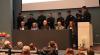
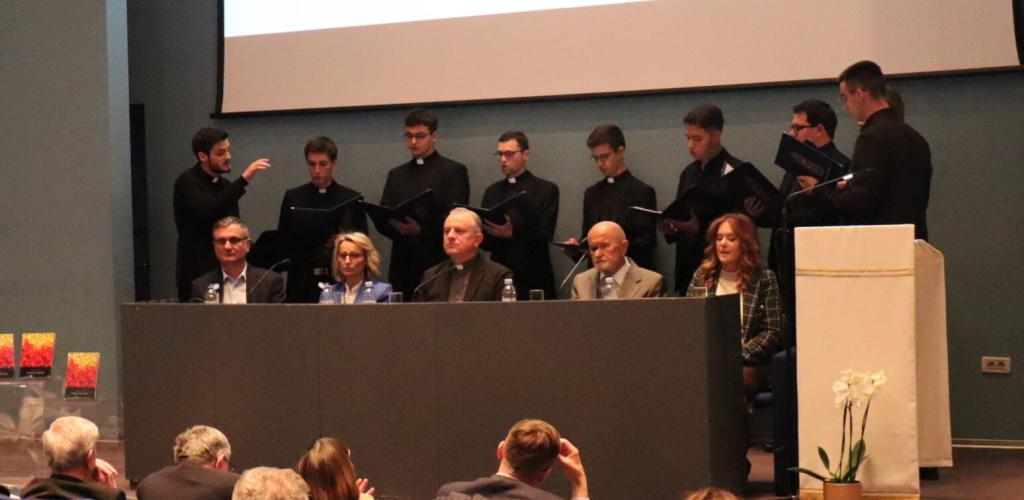
Presentation of the third, revised and expanded edition of Dr. Marko Lukenda’s book *The Presnački Martyrs* was held on Tuesday, May 12, in the ‘Vijenac’ Hall of the Archdiocesan Pastoral Institute in Zagreb.
The book was presented by the Rector of the Catholic University of Croatia, Prof. Željko Tanjić, PhD; the book’s editor, Prof. Krešimir Mićanović, PhD, from the Faculty of Humanities and Social Sciences at the University of Zagreb; Associate Professor Ana Biočić, PhD, from the Catholic Faculty of Theology at the University of Zagreb; and the author, Dr. Marko Lukenda. The presentation was also attended by Cardinal Vinko Puljić, Archbishop Emeritus of Vrhbosna, and Josip Mrzljak, Bishop Emeritus of Varaždin.
Recalling Fr. Lukenda, Cardinal Puljić emphasized that they had been connected through a long-standing friendship and shared priestly journey. ‘I experienced his priestly ministry together with him and we grew together, so in a special way I remember both his testimony and his martyrdom - first imprisonment, and later Presnače, where he was burned,’ he said.
Leafing through the book written by Marko Lukenda, Cardinal Puljić said it revived powerful memories and emotions within him. ‘What that man endured - and thanks to him for dying as a witness for his people!’ he stressed.
‘He is always in my thoughts as a courageous witness of faith. Courageous in the sense that he left a mark, not only through what he built, although he achieved a great deal, but because he left behind the light of faith,’ he said in his address.
Speaking about the tragic events of May 1995, the murdered priest’s brother and the book’s author, Marko Lukenda, recalled the final days of his life. ‘I do not know whether he sensed what might happen, but in his final homily in the parish on Sunday he said: “Many advise me to leave the parish or they will kill me.” He told the faithful: “I have decided to stay, and when my last parishioner leaves, I will go after him,” and that very night it happened,’ he said.
Recalling the crime itself, he said it was difficult to speak about the details. ‘They first took him from the parish house into the church and forced him to do something. Neighbours heard Filip’s voice from the church saying: “I will never do that, and you can do whatever you want.” After that, he was killed,’ he said, adding that no one has been held accountable for the crime to this day.
Speaking about the message of martyrs for the present day, Rector Tanjić emphasized that martyrs have much to say to people. ‘In the simplicity of faith and life, they remind us that there are values — or the One in whom we believe — who fulfills us, guides us, strengthens us, and gives us hope and strength in moments when we ourselves do not have the strength to accomplish far greater deeds than we think we are capable of,’ he stated.
‘I believe that the martyrdom of Fr. Filip and Sister Cecilija tells us exactly that. They remained faithful to their calling and to the people to whom they were sent. They remained faithful both to the place and the people entrusted to them. They could have chosen differently, but at that moment they felt deep within their conscience that they could not act otherwise, regardless of what awaited them. I would say that this is truly fidelity to conscience in life circumstances - remaining faithful to the fundamental divine calling planted within us, regardless of what lies ahead,’ added Rector Tanjić.
Associate Professor Ana Biočić, PhD, briefly presented the content of the book, emphasizing that it bears witness to the deep connection between the Catholic Church in Bosnia and Herzegovina and the Croatian people, a relationship often marked by sacrifice throughout history. ‘The book speaks about the ministry of parish priest Filip Lukenda, whose pastoral work was made difficult during communist rule. He arrived in the Parish of Presnače, in the suburbs of Banja Luka, in 1972, during the crackdown on the Croatian Spring,’ she said.
She emphasized that Fr. Lukenda encountered extremely difficult conditions upon his arrival. ‘He had nothing when he arrived. He built the parish from the very beginning — not only the church as a sacred building, but also the living Church, the community of believers. He started from an empty field without roads, through a barrack, all the way to a brick church,’ Prof. Biočić highlighted.
She recalled that shortly after the church was declared a shrine, Fr. Lukenda was arrested. ‘Only two months later, he was prosecuted and accused of hostile activities against the state, spending two years in prison in Foča. Afterwards, he briefly recovered in Zagreb because his health had been seriously damaged during imprisonment,’ she said.
She added that he soon returned to his Parish of Presnače, where the beginning of the Homeland War and wartime suffering in Bosnia and Herzegovina found him. ‘The parish priest received numerous threats, yet despite this he persisted in remaining with his people until he tragically suffered a martyr’s death on May 12, 1995,’ Prof. Biočić stressed.
The book’s editor, Prof. Krešimir Mićanović, PhD, reflected on the new edition of the book. ‘Mr. Lukenda expanded certain sections of his manuscript and added an entirely new chapter. He took into account events that occurred since the previous edition of the book. He mentions and records that a documentary film was made. He also notes that a canonization process has been initiated, or rather efforts have begun to launch such a process, and within the book he literary shaped memories of his brother and conversations with Bishop Pichler,’ he emphasized.
Highlighting the importance of the testimony of the Presnački Martyrs for Christians, Prof. Mićanović stressed the importance of preserving the memory of their sacrifice. ‘It is about ensuring that what happened is not forgotten. Mr. Lukenda successfully narrated this tragic story, supporting it with numerous documents and photographic materials,’ he concluded. The event was moderated by Emanuela Herceg.
Photo & text: IKA