Share
The Second UniCath Dialogues Theological Forum Held at CUC: “Theology Between Conservatism and Progressivism”
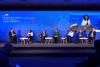
On Wednesday, 26 November 2025, the second theological forum of the Catholic University of Croatia, UniCath Dialogues, was held. The moderator, Assoc. Prof. Zoran Turza, PhD, welcomed the large audience, introduced the speakers, and opened the discussion.

The theme “Theology Between Conservatism and Progressivism” was launched by Asst. Prof. Jakov Rađa, PhD, who paraphrased the thought of Elmar Salman, noting:
“It seems that theology pleases no one any longer: for the devout it is not pious or holy enough, for liberals not liberal enough, for the socially engaged not social enough, for members of grassroots communities too official, for hedonists too moral, and for seekers of esoteric or existential meaning too sober.”
What unites these groups is their stance toward tradition, which for some represents an obstacle to progress, and for others a guarantee of permanence in a rapidly changing world.

Theology, he explained, is a living dialogue between the preservation of faith and its development. Church tradition is not a return to the past, but the transmission of divine revelation that includes responsibility and creative engagement in the present. Through apostolic tradition, unity of faith is preserved, while continued interpretation ensures growth in understanding, allowing faith to remain living and relevant across cultures and epochs. Citing St. Vincent of Lérins, Rađa reminded the audience that tradition calls for progress, but not change in the meaning of faith itself—truth may be expressed in new ways, but the essence of the Gospel must remain unchanged.
In summary, theology between conservatism and progressivism is not a battle against change, but a responsible openness to growth and authentic reinterpretation in fidelity to divine revelation, so that faith remains alive, meaningful, and capable of inspiring a response in every age.
The second speaker, Rev. Leopold Ćurčić, presented two theological models through which polarization within the Church can be understood: incarnationism and eschatologism.

He argued that polarization is not spontaneous but follows identifiable models of thinking—sets of perspectives, priorities, and practices shaped by coherent theological logics. These models are distinctly theological, though they overlap with political categories of conservatism and progressivism.
Incarnationism begins from the belief that God became incarnate, accepting earthly frameworks and working within them. Thus, such frameworks are seen as legitimate for the life of the Church. Characteristics include:
continuity between the natural and the supernatural,
the Gospel embedded within particular cultures and languages,
a positive view of the world as a valid “framework,”
openness to change in thought and practice over time,
emphasis on how the Gospel is received by people within their concrete experiences and contexts.
In contrast, eschatologism looks to the eschaton, the perfect future reality that functions as the standard by which the present world is judged. Compared to the heavenly reality, all earthly expressions—nature, culture, technology, history, even humanity itself—are seen as deficient, marked by the fall of humanity. This perspective often operates through strong dualisms: earthly–heavenly, human–divine, secular–spiritual, world–Church, heresy–orthodoxy, and others. Christianity is then perceived primarily as a call to transcend the earthly in anticipation of the heavenly kingdom, often accompanied by a more pessimistic view of human nature and a strong focus on doctrinal correctness as a criterion of belonging.
A special and unexpected highlight of the evening were reflections offered by three young participants who summarized the presentations and posed their questions to the speakers:
Petra Bubnić (First Economic School),
Klara Pažin, psychology student at the Catholic University of Croatia, and
Ana Jurić (15th Gymnasium – MIOC).
Their thoughtful contributions were warmly received by the audience. Recordings of their reflections are available via the link attached to the news item. The forum concluded with an open discussion, ending at 8:00 p.m.
The entire theological forum can be viewed at the link provided:
Reflection from a Participant
Following the previous forum, and with equally high expectations for this one, I anticipated a discussion framed within the familiar political dichotomy of conservatism versus progressivism—where everything ecclesial would be labeled outdated and traditional, while progressivism would be presented as liberating and modern, aligned with today’s media-driven moral compass and “woke” ideology.
Instead, I encountered a genuine surprise. The speakers spoke about everyday life and work, about the constant tension between doctrine and action, about living in time suspended between tradition and change, between incarnationism and eschatologism.
In this sense, the forum was a true refreshment—an escape from ideological pigeonholing and an invitation to active reflection on reality, offering a different conceptual framework that stimulates imagination rather than mere passive observation (“snotrenje”, as the Croatian writer K. S. Gjalski once described anxious existence).
(Marina Bucić)
Text: Assoc. Prof. Kristina Vujica, PhD